Globalisation is not disappearing. It is being rewired. As supply chains, strategic resources, infrastructure and capital flows become increasingly shaped by geopolitical competition, where does economic power actually sit and what should businesses be watching next?
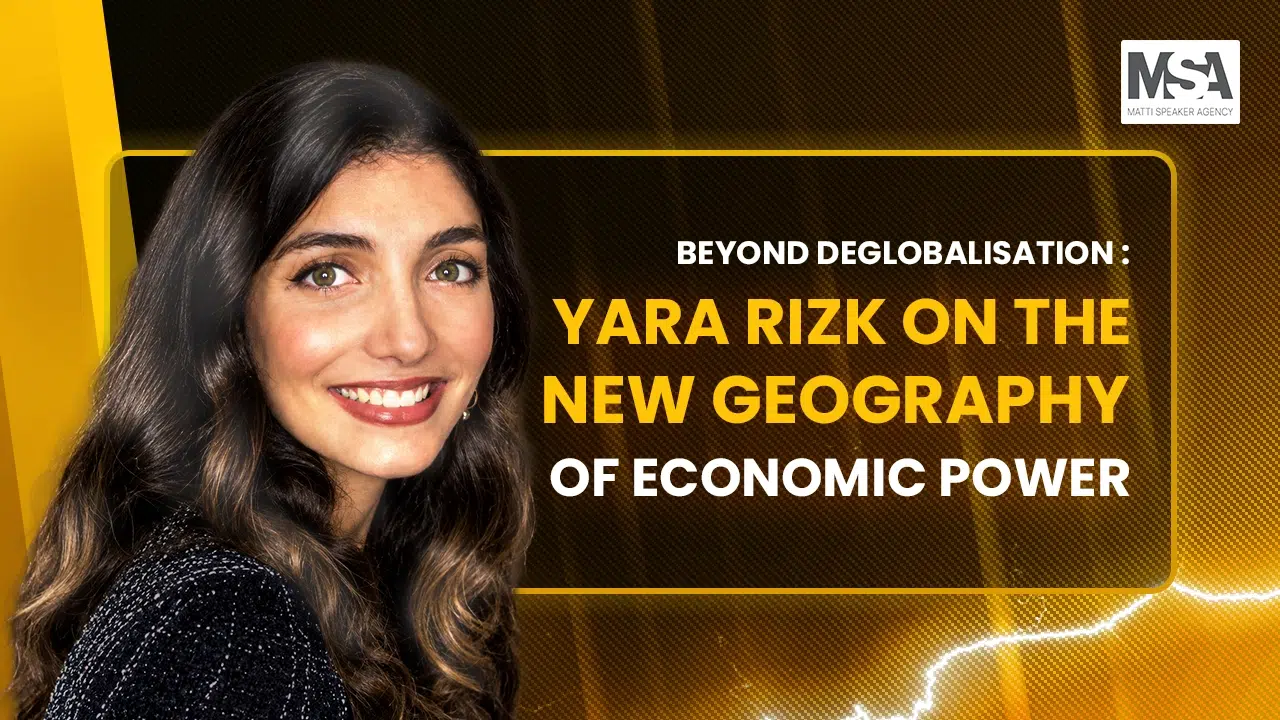
Matti Speaker Agency sat down with Yara Rizk, a journalist and geoeconomics consultant, to explore how global economic power is shifting beneath the surface. Drawing on her experience across the Middle East, Africa and Europe, Rizk examines the difference between wealth, value and power, why economic sovereignty is not about eliminating dependencies, how the physical infrastructure behind artificial intelligence is reshaping investment, and why sanctions are creating new routes through a parallel global economy.
1. Your career has taken you from field reporting to financing major infrastructure projects, across the Middle East, Africa and Europe. How have these experiences shaped your understanding of global economic power?
My experience has taught me that possessing wealth, capturing value and exercising power are three very different things. Reporting across Africa and the Middle East, I saw how countries essential to global supply chains could remain dependent on those financing, processing or transporting their resources. Working in infrastructure finance revealed another dimension: the structure of a deal can determine who captures value, who bears the risks and who retains control long after the investment is announced. Consider Indonesia. By restricting raw nickel exports, it compelled investors to develop domestic processing capacity. Yet Chinese companies still account for roughly 75% of its nickel refining capacity. Or take Djibouti: a small economy whose ports handle around 95% of Ethiopia’s imports, giving it strategic leverage, but also creating a profound dependence on Ethiopian trade. These examples reveal how interdependence is rarely symmetrical, and leverage is not the same as autonomy. They also challenge the idea that emerging economies are simply choosing between Washington and Beijing. Many are actively negotiating with competing powers, but their success depends less on the capital they attract than on the capabilities and options they retain. That is how I approach geoeconomics today: not by asking who possesses the most resources or attracts the most investment, but who controls the terms of exchange, who can replace whom, and how those relationships redistribute power over time.
2. You challenge the idea of deglobalisation, suggesting that dependencies are shifting rather than disappearing. What does a realistic approach to economic sovereignty look like for European businesses?
Europe should be less concerned with eliminating dependencies than with understanding which dependencies give others power over it, and which give Europe power in return. Consider semiconductors. Europe does not dominate advanced chip manufacturing, yet the Dutch company ASML supplies the world’s most advanced lithography equipment. Its strategic importance comes not from producing the final product, but from controlling a technological capability that is extraordinarily difficult to replicate. China has built a similar, though much broader, advantage in critical minerals. According to the IEA, it is the leading refiner of 19 out of 20 strategic minerals examined. Its leverage lies less in owning the world’s mineral deposits than in controlling the industrial processes that turn those resources into usable inputs. This exposes a weakness in Europe’s industrial debate. Building a battery factory in Europe does not make its supply chain European. It may still depend on Chinese refining, imported components and technologies developed elsewhere. We risk confusing industrial presence with strategic control. For businesses, the question is therefore not simply where to produce, but which dependencies are replaceable, how quickly alternatives can be developed, and what a disruption would actually cost. Some dependencies are economically rational. Others are existential vulnerabilities. Europe needs to diversify the latter, invest in capabilities that are difficult to substitute, and resist the temptation to pursue self-sufficiency at any cost. To me, sovereignty is not about eliminating dependencies. It is about ensuring that no single partner can dictate your choices.
3. Behind artificial intelligence lie chips, electricity, water and critical minerals. How are these physical needs reshaping the geography of economic power and creating new investment opportunities?
The more sophisticated our digital economy becomes, the more it depends on some very traditional industrial constraints. According to the IEA, data centres consumed around 415 TWh of electricity in 2024, a figure projected to more than double by 2030. Yet the challenge is not so much producing enough electricity globally as delivering it where it is needed, when it is needed. A data centre can be financed relatively quickly, while securing a grid connection may take years. Ireland’s grid congestion and Singapore’s restrictions on data-centre development illustrate how physical constraints are already influencing investment decisions.This is quietly redrawing the geography of economic power. Silicon Valley may concentrate talent, capital and innovation, but competitive advantage increasingly extends to regions with reliable energy, available grid capacity and the industrial capabilities to support large-scale computing. In the race for artificial intelligence, access to power is becoming as strategic as computing power itself. For investors, this opens opportunities well beyond AI developers and semiconductor manufacturers, particularly in electricity networks, transformers, cooling technologies, energy storage and connectivity. But identifying a bottleneck is not the same as capturing its economic value. Regulation, power contracts and capital intensity ultimately determine who earns the returns. We tend to ask who will develop the most powerful AI. I am equally interested in who will control the infrastructure that makes it possible. And this is something I follow closely in my work.
4. You describe a “parallel global economy”, where trade adapts and finds new routes around sanctions. What does this reveal about the limits of Western economic power, and what consequences should businesses anticipate?
Sanctions rarely eliminate trade. They redirect it, often making it more expensive, complex and opaque. Russia has shifted much of its oil exports towards China and India. Iran continues to sell substantial volumes of crude to China despite decades of sanctions, while Venezuela has repeatedly found alternative buyers and trading arrangements. These examples do not mean sanctions are ineffective. They can severely constrain revenues, investment and access to technology. But they often change the economics of trade rather than bringing it to a halt.. This reveals a paradox of Western power. The dominance of the dollar, Western financial institutions and technologies gives the United States and Europe considerable leverage. Yet the more these networks are used to exert pressure, the greater the incentive for other countries to develop alternatives. We are witnessing a reconfiguration of globalisation, with trade increasingly flowing through fragmented and often less transparent networks. For businesses, the implications extend beyond sanctions compliance. Geopolitical exposure may be hidden several layers down a supply chain, through traders, shipping companies, financial intermediaries or critical suppliers.
5. You suggest assessing crises through what they could disrupt: supplies, trade routes or infrastructure. Which blind spots should business leaders examine first to better prepare their organisations for the next global shock?
The first blind spot is hidden concentration. A company may have five suppliers in five countries, yet all five depend on the same semiconductor manufacturer, mineral refinery or shipping corridor. What looks like diversification on paper may be a single point of failure in practice. The second is the time it takes to find an alternative. When the Red Sea became unsafe for commercial shipping, vessels could reroute around the Cape of Good Hope, but at the cost of longer journeys, higher freight expenses and disrupted delivery schedules. Other dependencies, such as specialised industrial equipment or electricity infrastructure, can take years to replace. The third is financial contagion. A disruption does not have to interrupt production to damage a business. Higher insurance premiums, energy prices, financing costs or working-capital requirements can be enough to undermine its economics. The real measure of resilience is not how many alternatives a company has, but how quickly it can activate them, at what cost, and for how long.
Bring Yara Rizk’s Perspective on Geoeconomics and Global Power to Your Stage
Yara Rizk offers a distinctive perspective on how economic power is being reshaped by geopolitical competition, shifting dependencies, strategic resources and infrastructure. Her experience across journalism, infrastructure finance and geoeconomics allows her to connect global political developments with the practical realities facing businesses, investors and policymakers.
As a keynote speaker on geoeconomics, geopolitical risk, emerging markets, strategic resources and the changing global economy, Rizk helps audiences understand where vulnerabilities are emerging, how dependencies translate into leverage, and what businesses can do to build resilience before the next global shock.
To bring Yara Rizk’s insights to your next summit, conference, or corporate event, contact Matti Speaker Agency today.