Sustainability is often framed as a cost, a compliance requirement, or a long-term responsibility. But what if it can become a source of growth, innovation and competitive advantage? For business leaders facing resource scarcity, technological disruption and changing geopolitical realities, the question is no longer whether sustainability matters, but how to make it commercially valuable.
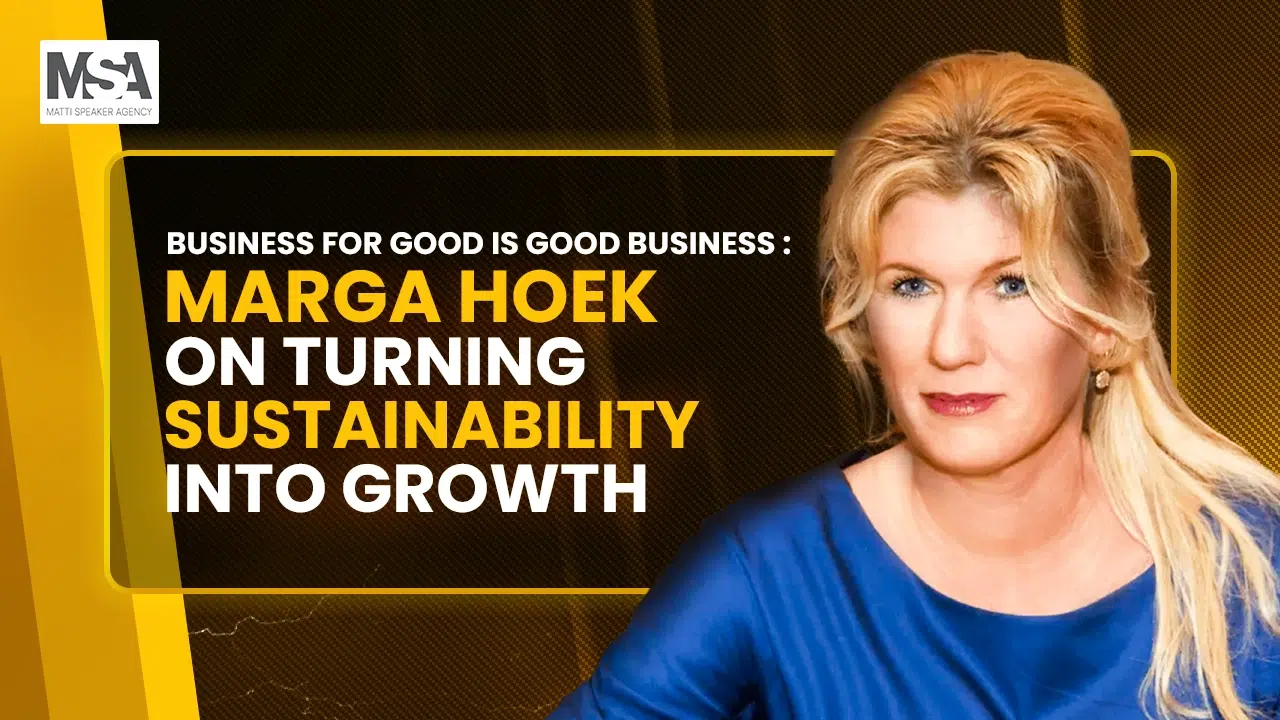
Matti Speaker Agency sat down with Marga Hoek, three-time CEO, globally recognized business strategist, and keynote speaker on sustainable business, future leadership and technology for good, to explore how companies can turn sustainability into profitable business models. Drawing on her experience leading companies and researching breakthrough technologies and business models around the world, Hoek discusses why sustainability can strengthen profitability, how technology can create more value with fewer resources, why sovereignty is becoming a boardroom issue, and how circularity can turn resource scarcity into a competitive advantage. Her work sits at the intersection of business, technology and positive impact, with a focus on helping leaders build future-ready companies.
1. What has being a CEO taught you about making sustainability profitable?
As a three-time CEO, my experience is grounded in leading companies, in reality. I have learned to look for the commercial value that conventional business models leave unexplored. My experience in construction, infrastructure and investment taught me how dramatically the economics change when you consider an asset’s entire life: its energy consumption, maintenance, materials and future value. That opens up a much more interesting conversation about investment, innovation and profitability. I learned to unlock new markets and creating profitable business models, achieving high growth, by thinking and acting this way. Consider the lighting model Philips introduced at Schiphol: the airport pays for light, while the provider retains ownership of the equipment and responsibility for its performance and recovery. The commercial incentives change. Durability, efficiency and recoverable materials become valuable to the supplier.
This is what I mean by “Business for Good is Good Business”: designing a business so that creating positive impact strengthens the way it earns money.
2. What separates “tech for good” from technology that simply sounds promising?
The evidence lies in what the technology makes possible and the value it actually delivers. One of its most powerful capabilities is helping businesses do more with less: increase output and commercial value while reducing pressure on the planet.
Agriculture offers a striking example. Digital platforms combine soil sensors and automated irrigation to give crops precisely the water they need. On average they report around 15 to 20% higher yields using around 60% less irrigation water. More crop, less water: the farmer’s business case improves while demand on a scarce resource falls. There are many examples like these, which I mention during my keynotes.
Advanced materials open up equally remarkable possibilities. At Mexico City’s Torre de Especialidades hospital, a specially coated façade helps break down air pollutants, with an estimated capacity equivalent to the smog-forming pollution produced by up to 1,000 cars a day. A building’s exterior becomes an active part of improving its surroundings, the lungs of the city so to say. That creates opportunities for the companies developing these materials and for the cities using them.
My award-winning book Tech for Good brings together 75 real business cases like these from around the world. What excites me is the extraordinary range of opportunities they reveal. In my keynotes, I bring those possibilities to life, explain the business models behind them and help audiences recognize where a similar opportunity could exist in their own industry.
3. You describe sovereignty as a business issue. Which dependencies should leaders examine first?
Start with whatever could stop your company from delivering, even with a full order book. That might be electricity, a critical material, a semiconductor, digital infrastructure or access to capital. Leaders need to understand who controls access, how quickly they could find an alternative, and what happens if political decisions suddenly change the terms. A dependency buried several layers down a supply chain can determine the future of the entire business. This is central to my work on sovereignty.
My forthcoming book, Sovereignty Is Now Serious Business, explores how companies can turn that exposure into commercial opportunity. Recovering strategic materials, securing energy and
developing trusted digital infrastructure can create new businesses as well as greater resilience. Sovereignty is becoming part of how companies compete—and an increasingly compelling subject for the boardroom and the conference stage.
4. How can circular business models turn resource scarcity into an advantage?
By creating more value from the materials and products a company already has. Renault’s Refactory in Flins shows what this looks like at industrial scale: reconditioning used vehicles, repairing batteries, refurbishing components and recovering materials. Each activity opens another commercial opportunity within the life of a vehicle.
For a business leader, the implications reach well beyond waste reduction. Repair, refurbishment and services can generate revenue, extend customer relationships and reduce exposure to scarce inputs. Products already in circulation become a potential source of future supply. I find that particularly exciting because it connects three urgent business priorities: profitability, sustainability and greater control over resources, which is a cornerstone to sovereignty. In a keynote, these cases help people see how much value their own industry may still be leaving behind.
5. What does courageous leadership look like when short-term pressures challenge long-term ambitions?
Courage becomes visible in the decisions a company funds and rewards. If circularity is a strategic priority, but teams are rewarded solely for selling more new products, the incentive system will work against the ambition. Leaders have to address that: change targets, test different revenue models and commit resources to developing the capabilities the business will need.
My experience as a CEO and board member has taught me that people need a credible connection between the future being described and the decisions being made today. That takes commercial discipline, clear judgment and the willingness to reconsider a successful formula while you still have room to act. It also means being serious about implementing your vision and objectives into the KPI’s. What you reward, will grow. A compelling vision gives people direction; visible commitments give them confidence to move.
6. What do audiences take away from a keynote with you?
I take audiences into businesses that are already doing things many people still consider to be in the future and I connect those examples to the decisions facing their own industry now. I confront the changing realities of business through concrete numbers, showing how technology, resource pressures and geopolitics are reshaping competition. Then I bring the opportunities to life through clear ideas and compelling cases from around the world, demonstrating what companies are already achieving and how others can put those ideas to work.
As a three-time CEO and board member, I bring a businessperson’s perspective alongside the international research behind my books. My optimism is grounded in experience and evidence:
I see the extraordinary ingenuity businesses can bring to solving problems while creating commercial value. That conviction runs through my keynotes. I want people to leave inspired and empowered, with concrete opportunities to pursue and convincing arguments to bring their colleagues, customers and investors along. A powerful keynote builds a can-do mentality that people carry back into their businesses, giving them the confidence and direction to start.
Bring Marga Hoek’s Vision of Sustainable Business and Technology to Your Stage
Marga Hoek challenges the idea that sustainability and profitability are opposing forces. As a three-time CEO and internationally recognized strategist, she brings a business-first perspective to sustainability, technology and long-term value creation. Her work explores how companies can turn resource constraints, technological change and geopolitical shifts into opportunities for innovation and growth.
As a keynote speaker on sustainable business, technology for good, circular economy, future leadership and business transformation, Hoek gives audiences concrete examples of companies already creating commercial value while addressing some of the world’s most pressing challenges.
To bring Marga Hoek’s insights to your next summit, conference, or corporate event, contact Matti Speaker Agency today.