Disruption is no longer an interruption to business as usual. It is becoming the baseline. So if uncertainty is permanent, why are so many organizations still designed around predictability, stability, and planning for the world they already know?
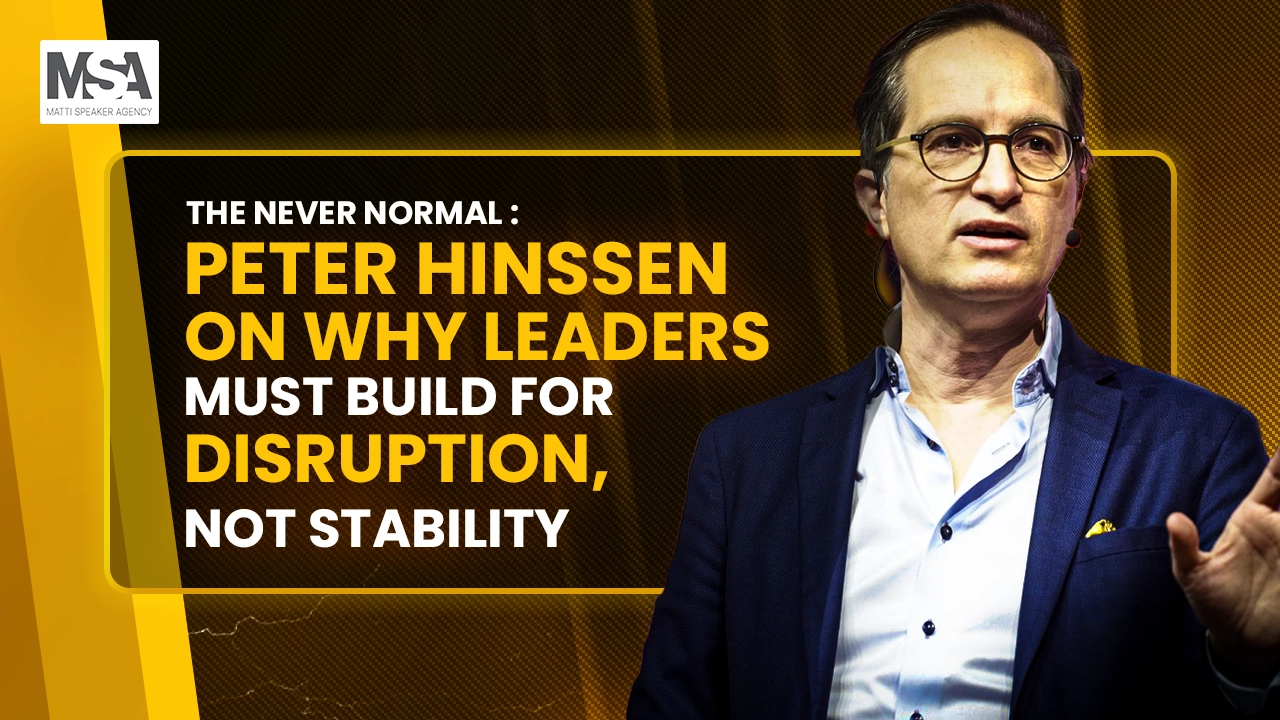
Matti Speaker Agency sat down with Peter Hinssen, technology entrepreneur, author, and thought leader on innovation and the future of business, to discuss what it takes to lead in what he calls “The Never Normal.” From investing in the Day After Tomorrow and building “Phoenix” companies to understanding the real role of AI and cultivating curiosity as a leadership skill, Hinssen argues that organizations cannot simply prepare for disruption. They need to architect themselves to respond to it.
-
You’ve spent years arguing that “The Never Normal” is not a phase but a permanent state. Most leaders intellectually accept this,yet their organizations are still built for stability. What are they missing?
The gap is not cognitive. It is structural. Leaders understand that the world has changed. But they are still running organizations designed for predictability,with planning cycles, approval processes, and incentive systems built for a world that rewarded consistency.
The Never Normal is not about being surprised by disruption. It is about building organizations that treat disruption as the baseline condition. The question is not whether change will come. It is whether your organization is architected to respond before the change forces your hand.
Most companies spend roughly seventy percent of their energy optimizing Today, twenty percent extending what already works into Tomorrow, and a shockingly small percentage of time, if any imagining the Day After Tomorrow. That ratio almost made sense in a stable world. In a Never Normal world, it is a recipe for slow obsolescence. So I always tell companies to invest at least 10% of their time and budget in their Day After Tomorrow.
-
Most leaders agree they should spend more time thinking about the Day After Tomorrow. Yet very few actually do. Is that a resource problem or a leadership problem?
It is almost never a resource problem.
Organizations allocate resources according to what leaders truly prioritize. Most companies can find budget for operational improvements, acquisitions, compliance projects, or cost reduction initiatives. What they struggle to find is protected space for exploring futures that may challenge today’s assumptions.
That last phrase is the key. The Day After Tomorrow is uncomfortable precisely because it questions the assumptions on which Today’s success is built. Most organizations reward people for defending those assumptions, not for challenging them.
The Day After Tomorrow is not a forecasting exercise. It is a strategic discipline. It requires leaders to spend time on opportunities and threats that may not materialize for years, while resisting the gravitational pull of immediate operational concerns.
Most disruptions do not arrive suddenly. They are visible for years before they become unavoidable. What varies is not the signal. It is the willingness to act on it before the pressure to act becomes impossible to ignore.
-
You describe “Phoenix” companies as those capable of radical self-reinvention. What separates them from organizations that simply talk about transformation?
Let me start by contrasting them with Unicorns. These are born disruptive and enter markets without the burden of legacy systems, established customer contracts, or ten layers of management approval. They are designed for speed.
Phoenix companies are different. They are incumbents — organizations with history, infrastructure, and obligations. And yet they are capable of reinventing themselves from within, often more durably than the startups trying to unseat them.
LEGO, for instance was brave enough to strip itself back to its core, and rebuilt into one of the most valuable entertainment brands on earth. Not by chasing every trend, but by understanding what it fundamentally was — and then reimagining every dimension of how it delivered that. One example is using AI to help customers identify and build new sets from the bricks they already own by simply scanning them.
The most dangerous moment for any organization is when everything appears to be working. Revenue is strong. Customers seem satisfied. The board is pleased. That is precisely when a Phoenix leader should be asking the most uncomfortable question: what would we do if a smarter, faster, better-funded version of us appeared tomorrow?
And here is the question I find even more revealing: if that company existed, would your best people want to work there instead of here?
The difference between a Phoenix and a company that merely talks about reinvention is that the former begins that conversation before it is forced to. Reinvention is not their crisis response. It is their operating model.
-
AI is the latest technology wave capturing executive attention. How can leaders distinguish between genuine transformation and expensive distraction?
The organizations getting it wrong are asking: “How can we use AI?” The organizations getting it right are asking: “What future are we trying to build — and how does AI accelerate that future?”
It is a subtle distinction with enormous consequences.
When AI becomes the strategy rather than a means to an end, organizations end up automating existing processes and calling it transformation. It is not. Efficiency matters when you have already decided what business you are in. The harder question is whether that business is still the right one.
The most interesting organizations use AI as a catalyst to rethink customer experiences, business models, and value creation itself. They are not asking what AI can improve. They are asking what AI makes possible that was previously unimaginable.
Most organizations do not have an AI problem. They have a clarity-of-purpose problem. AI simply makes that visible faster.
-
If you could prescribe one mental shift for leaders navigating the next decade, what would it be?
Cultivate genuine curiosity as a survival mechanism.
Most leadership cultures are built to reward certainty. We promote people who have clear answers, crisp plans, and confident execution. That selection process worked well when the environment was stable. In a Never Normal world, it systematically removes exactly the people you need.
The leaders I most respect have learned to hold questions open long enough to find genuinely new answers, rather than defaulting to familiar ones. They have the discipline to resist premature closure when the situation genuinely demands a different kind of thinking.
We are living through one of the most extraordinary periods in human history. The tools available to us and the possibilities that have opened are remarkable. But accessing them requires a willingness to not know, be wrong and rebuild.
The leaders who will define the next decade are not the most confident. They are the most curious. Because that is the skill that helps them navigate deep uncertainty and turn the challenges of a Never Normal world into opportunities.
Bring Peter Hinssen’s Vision of Leadership in a Never Normal World to Your Stage
Peter Hinssen challenges leaders to stop treating disruption as an exceptional event and start building organizations designed for permanent uncertainty. His insights on The Never Normal, the Day After Tomorrow, organizational reinvention, AI, and curiosity give leadership teams a practical framework for navigating a world where yesterday’s assumptions can quickly become tomorrow’s liabilities.
As a keynote speaker on technology, innovation, leadership, and the future of business, Peter Hinssen equips audiences to think beyond immediate challenges and prepare for what comes next — before they are forced to.
To bring Peter Hinssen’s insights to your next summit, conference, or corporate event, contact Matti Speaker Agency today.