
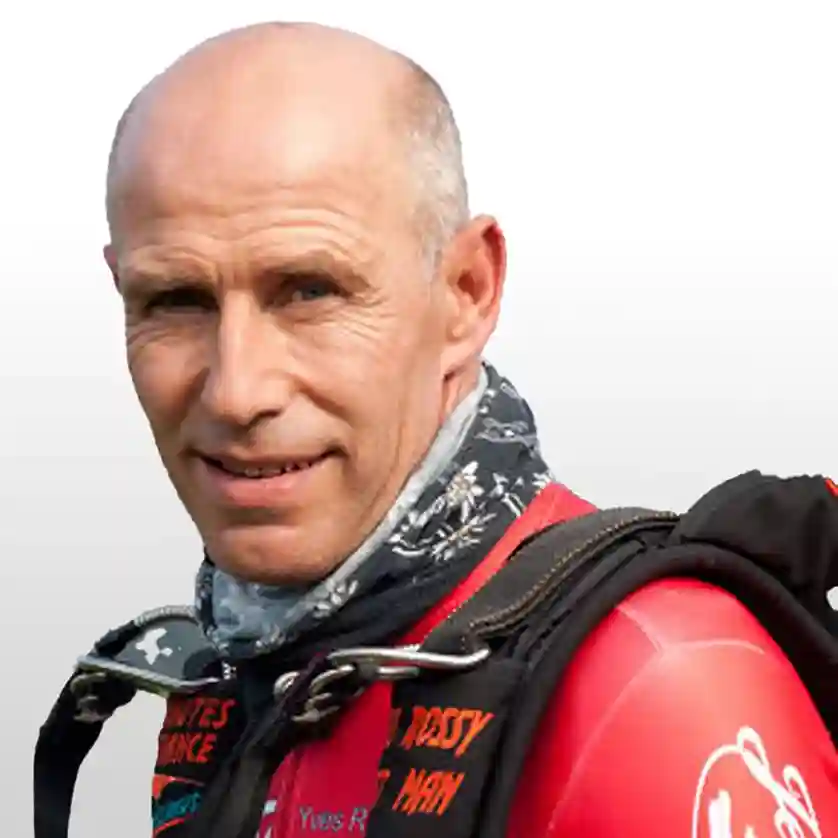
In 2004, Yves Rossy made aviation history by becoming the first man to fly with a jet-propelled wing. After completing his training as a military pilot, Rossy flew aircraft such as the Hawker Hunter and the Mirage III. He later transitioned to a career as a commercial airline captain with Swiss International Air Lines, flying Boeing and Airbus airliners.
Driven by a passion for experimental flight, Rossy aimed to fly in the purest form possible, minimizing the constraints of being enclosed in an aircraft shell. Initially drawn to free-fall activities like sky surfing and wing suiting, he sought to extend his flight time and control his trajectory, moving towards true flight rather than just falling. He developed his first real wing with a rigid harness and inflatable wing tips, which he strapped to his back. While this innovation prolonged free fall, it still wasn’t enough for his vision of human flight.
To achieve sustained and controlled flight, Rossy improved his wing by adding propulsion with model jet turbines. Initially, he used two turbines, allowing him to maintain level flight in 2004. By 2006, he added four turbines, enabling him to fully conquer the third dimension of flight. His flights were controlled by manipulating his body as an extension of the wing, without the need for an enclosed cockpit or mechanical controls. His only instruments were an altimeter and a hand-held throttle.
Rossy continued to optimize his wing’s handling and performance. In May 2008, he gained worldwide attention with his first official flight over the Swiss Alps. In September 2008, he retraced Louis Blériot’s historic flight path across the English Channel, a feat broadcast live to 165 countries.
In 2014, Rossy relocated to Dubai to further develop his dream of flying with the support of local partner XDubai. In May 2015, Jetman Dubai introduced Rossy’s protégé, Vince Reffet, an accomplished skydiver known for his gravity-defying feats. Trained and mentored by Rossy, Reffet joined him in developing exhilarating formation flights, bringing the joy of flight to a larger audience.
In 2004, Yves Rossy made aviation history by becoming the first man to fly with a jet-propelled wing. After completing his training as a military pilot, Rossy flew aircraft such as the Hawker Hunter and the Mirage III. He later transitioned to a career as a commercial airline captain with Swiss International Air Lines, flying Boeing and Airbus airliners.
Driven by a passion for experimental flight, Rossy aimed to fly in the purest form possible, minimizing the constraints of being enclosed in an aircraft shell. Initially drawn to free-fall activities like sky surfing and wing suiting, he sought to extend his flight time and control his trajectory, moving towards true flight rather than just falling. He developed his first real wing with a rigid harness and inflatable wing tips, which he strapped to his back. While this innovation prolonged free fall, it still wasn’t enough for his vision of human flight.
To achieve sustained and controlled flight, Rossy improved his wing by adding propulsion with model jet turbines. Initially, he used two turbines, allowing him to maintain level flight in 2004. By 2006, he added four turbines, enabling him to fully conquer the third dimension of flight. His flights were controlled by manipulating his body as an extension of the wing, without the need for an enclosed cockpit or mechanical controls. His only instruments were an altimeter and a hand-held throttle.
Rossy continued to optimize his wing’s handling and performance. In May 2008, he gained worldwide attention with his first official flight over the Swiss Alps. In September 2008, he retraced Louis Blériot’s historic flight path across the English Channel, a feat broadcast live to 165 countries.
In 2014, Rossy relocated to Dubai to further develop his dream of flying with the support of local partner XDubai. In May 2015, Jetman Dubai introduced Rossy’s protégé, Vince Reffet, an accomplished skydiver known for his gravity-defying feats. Trained and mentored by Rossy, Reffet joined him in developing exhilarating formation flights, bringing the joy of flight to a larger audience.