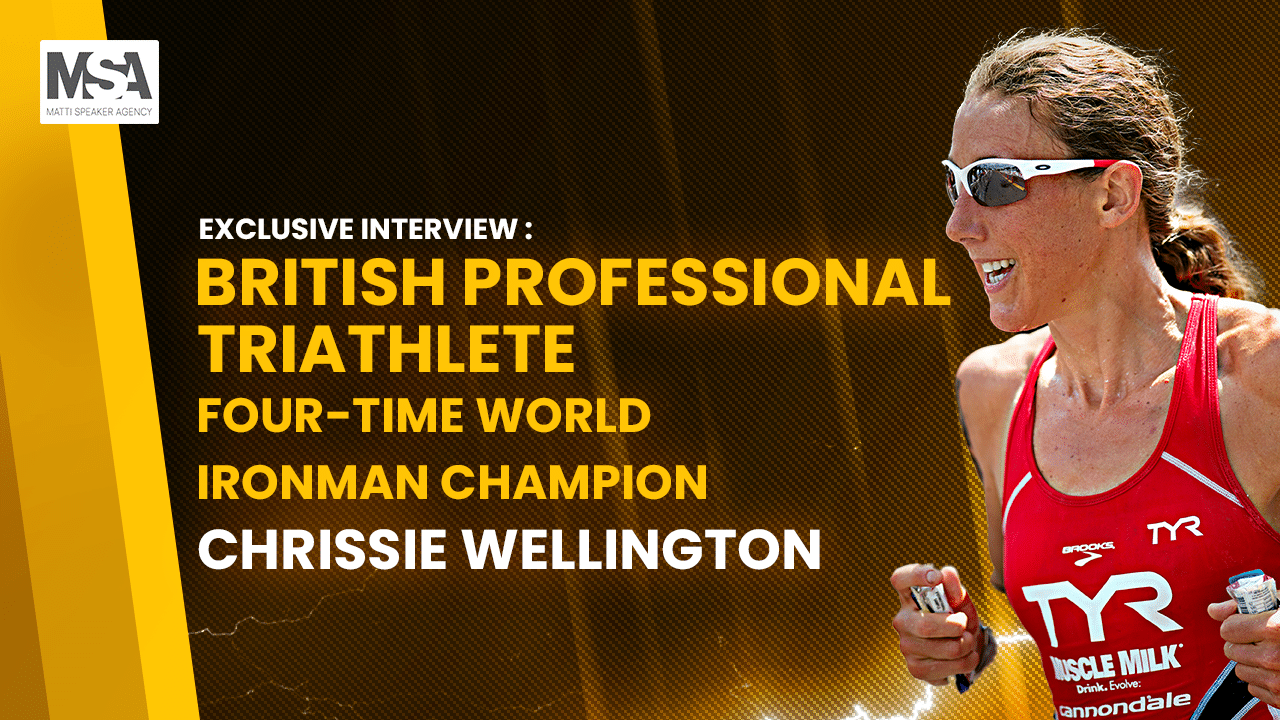
Chrissie Wellington is more than a sporting icon. As a four-time Ironman World Champion, she dominated one of the toughest physical challenges on earth. But today, she is making waves in the corporate world as a Global Head of Health and Wellbeing and a sought-after keynote speaker.
Matti Speaker Agency sat down with Chrissie to discuss the parallels between endurance sports and business leadership, the true definition of resilience, and why “failing upwards” is the key to growth.
You’ve dominated one of the toughest sports on earth – Ironman triathlon. What mindset and habits helped you achieve peak performance, and how can these apply to business leaders facing high-pressure environments?
Ironman taught me that sustainable peak performance, in sport or in business, is never about one single heroic act. It’s the product of purposeful, value-aligned choices made consistently over time. I relied on some vital and core habits: clarity of purpose, bold curiosity, setting ambitious yet iterative goals, creating intentional plans, reviewing and recalibrating and then executing the brilliant basics every single day. It’s about doing the ‘little big things’ things, sleep, nutrition, rest, focus, relentlessly well, as well as the macro, big ticket tasks.
Just as importantly, I learned to accept and embrace uncertainty and step outside my comfort zone, because growth and opportunity live on the other side of fear. I believe that resilience comes not from avoiding hardship, but from ‘failing upwards’: using setbacks as fuel for learning, rather than reasons to stop.
For leaders, the parallels are unmistakable: define what matters, align actions with values, cultivate environments that enable people to thrive, celebrate progress, bring people together, respect and value diversity in strengths, backgrounds and perspectives, and trust in the power of possibility. High performance is never accidental; it’s intentional, consistent, and also deeply human.
Many people know you for your athletic triumphs, but few know you started your career in international development. How did your experience working in global health and policy shape your approach to sport, and later, leadership?
Working in international development grounded me in purpose. It taught me to ask: What matters? Who am I serving? What change do I want to see? That lens carried directly into my sporting career and later into my role as Global Head of Health and Wellbeing for the global charity, parkrun.
In development, you quickly learn that meaningful progress comes from collaboration; rising together, not acting alone. You learn to listen with empathy, to work across and celebrate diverse cultures, and to co-create solutions that are sustainable. Those experiences shaped my approach to training, racing, and leading: every achievement, like every global health outcome, is the product of many hands and many diverse assets.
It also taught me the power of resilience, of people, communities and the environment. The ability to navigate and respond to adversity, choosing agency, focusing on what is possible rather than what isn’t, controlling the ‘controllables’ and forging a path with positivity and optimism. Resilience is ground in good health, and through international development and sport, I was reminded of the importance of health and wellbeing as a foundational pillar for peak performance in work, and life generally. I remain passionately committed to supporting others to optimise their health, and live a personal best life where they are able to fulfil their potential.
This work also embedded a sense of privilege and responsibility. Sport became not just a personal pursuit but a platform – an opportunity to “be the change” and to pay it forward. That mindset continues to guide me today.
You often speak about the importance of resilience, both mental and physical. What does true resilience look like to you, especially beyond sport; in work, life, and personal growth?
True resilience isn’t about being unbreakable; it’s about becoming a master at overcoming hard moments. It’s the ability to fall, to feel the setback fully, and then to rise again with greater clarity and capacity. To me, resilience rests on a few pillars:
- Expectation of highs and lows: Success comes because of setbacks, not despite them.
- Reflection and recalibration: Pausing, learning, adjusting rather than pushing blindly forward.
- A supportive environment: We shape our environment, and it shapes us. When we surround ourselves with diverse, uplifting communities, we’re better equipped to endure and to grow.
- Health: the better your mental, emotional, physical and social health and wellbeing the more resilient you can be.
- Belief in possibility: Trusting that your potential is far greater than your fear.
Beyond sport, resilience is a life skill. It shows up when navigating workplace change, caring for family, or rediscovering purpose. It’s a practice not a trait, one built through exploration, failure, courage and curiosity.
After retiring from professional sport, you’ve committed yourself to promoting health and wellbeing for all. Why is inclusion in sport and movement so critical today, and what can organisations learn from this in their own cultures?
Inclusion in sport matters because movement is a human right: a source of joy, confidence, community and wellbeing. But participation isn’t evenly accessible. Barriers like representation, environment, cost, confidence, or culture prevent many people from taking that first step.
When we make movement inclusive, when every body, background and ability is welcomed, we unlock human potential. People feel seen, valued, and empowered to try, to fail, to grow. But we need to understand the many barriers that people face in being regularly active, and co-create solutions that encourage them to take their first and sustained steps to health.
Organisations can learn a great deal from this:
- Design environments that help people thrive rather than hinder them.
- Cultivate unity in diversity: Different strengths, backgrounds and voices create resilience and innovation.
- Co-create solutions: Inclusion sticks when people feel ownership.
- Build cultures of trust, empathy and openness.
Ultimately, inclusion isn’t a nice-to-have; it’s the foundation for collective performance. We rise higher when we rise together; when we celebrate diversity and see that as something that brings strength and power.
I will continue to what I can to ensure that everyone, no matter who they are, can benefit from the beautiful act of moving their bodies by removing the barriers that exist and tapping into the motivational triggers that might compel them to make the change.
If you could leave one message with every audience you speak to, whether corporate executives or young athletes, what would it be?
Live the most significant life you can muster. One defined not by limits, but by purpose, courage and possibility. Your potential is far greater than you imagine. Step outside your comfort zone, make bold choices, embrace the highs and the lows, focus on the brilliant basics, and trust that small, consistent actions pave the path to extraordinary outcomes. And as you grow, help others grow too. Pay it forward. Because together, anything is possible.
Bring the Champion Mindset to Your Next Event
Chrissie Wellington’s insights on resilience, wellbeing, and high performance transform audiences. To check her availability for your next conference or corporate event, contact Matti Speaker Agency today.