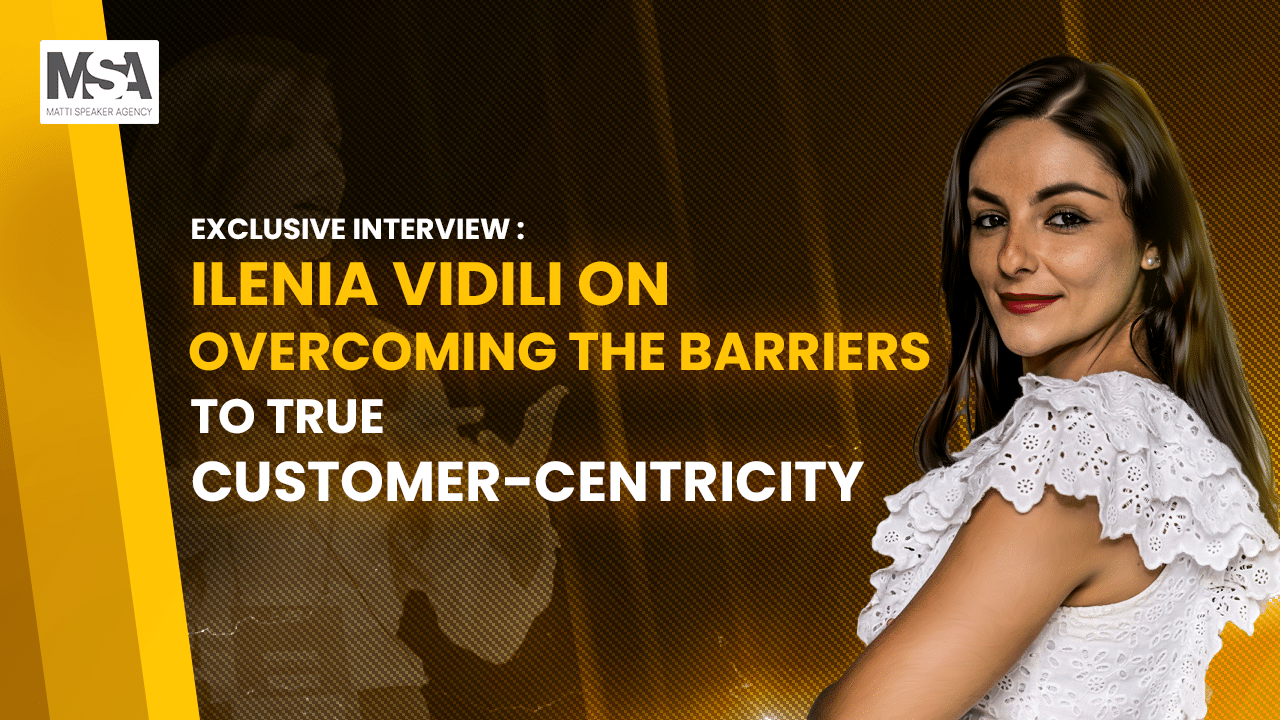
Most business leaders genuinely want to put the customer first. Yet, despite these good intentions, the gap between what companies promise and what customers actually experience remains vast. Why is it so difficult for organizations to transition from a product-driven mindset to a truly customer-centric culture?
Matti Speaker Agency recently sat down with Ilenia Vidili—a globally respected customer-centricity advisor, professional keynote speaker, and author of Journey to Centricity—to uncover why organizations struggle to make this shift, where they get it wrong, and the practical steps required to build lasting trust in an era of rapid technological change.
Q : You often speak about the shift from product-driven organisations to truly customer-centric companies. What are the biggest barriers that prevent leaders from making this transition successfully?
The biggest barrier is rarely a lack of intention. Most leaders I work with genuinely want to build organisations where customers are at the centre. The difficulty lies in what stands between that intention and the experience customers actually have.
The first barrier is leadership commitment, and I want to be precise about what that means. It is not about caring or not caring. It is about whether customer centricity becomes a real priority, reflected in decisions, resources, and behaviour, or whether it stays in the language of the strategy without changing how the organisation actually operates. Transformation of this kind asks leaders to model the behaviours they want to see, to make customer outcomes a consistent reference point across functions, and to stay accountable to that even when short-term pressures push in a different direction. That is a genuine commitment, not a statement. And it is harder than it sounds.
The second barrier is silos. Most organisations are structured around functions with separate goals, separate metrics, and separate accountabilities. Each team is doing its job well. But customers do not move through one department at a time. They move through the whole organisation, and they feel every handover, every gap in communication, and every moment where the left hand did not know what the right hand was doing. As long as no one is accountable for the full journey, the experience will always have cracks in it, even when every individual team believes it is doing its part.
The third barrier is the absence of a shared customer culture. This is perhaps the most underestimated one. Customer centricity is not a programme or an initiative. It is a set of repeatable behaviours, and those behaviours need to be understood and practised across the entire organisation, from the front line to the back office. When only certain teams feel responsible for the customer, the rest of the business makes decisions in a vacuum. A genuine customer culture means that everyone, regardless of their role, understands how their work connects to the experience customers have. Without that, the strategy remains on paper.
These three barriers are connected. Leadership commitment shapes culture. Culture shapes whether silos are challenged or protected. Addressing all three together is what makes the difference between a transformation that changes behaviour and one that only changes the presentation.
Q: In your work with global organisations, where do you most often see the gap between what customers expect and what companies actually deliver?
The gap shows up most clearly at the moments customers remember most: when something does not go as expected.
It is rarely the failure itself that does the most damage. Customers are more resilient than companies tend to assume. What damages trust is what happens next. When a customer who has experienced a problem then encounters a fragmented process, a response that sounds scripted but solves nothing, or a system that moves them from team to team without resolution, the message becomes very clear: this organisation was not designed with you in mind.
I also see the gap consistently at handover points, the moments when responsibility passes from one team or system to another. These are where the internal structure becomes visible in the worst way. Customers are expected to re-explain their situation. Information they have already shared is not carried forward. They absorb the friction of a business that has not communicated internally. None of this is usually intentional. But that does not make it less felt.
And there is a persistent gap around fairness. Customers often notice that the energy and attention they received while being won did not carry into the relationship after the contract was signed or purchase was made. Loyalty is expected, but it is not always sufficiently earned. Customers remember how they were treated long after they have forgotten the original promise.
Q: Your book Journey to Centricity presents a framework for becoming customer-centric. What are the first practical steps a company should take to begin this transformation?
The framework in Journey to Centricity is built around three pillars. Humanity is the “why”:
purpose, empathy, and trust. Technology is the “how”: using data, ease of use, and innovation as genuine enablers of better customer experiences, not as shortcuts. Culture is the “who”: the people, leadership behaviours, and mindsets that either make customer centricity real or keep it theoretical.
Those three pillars give a complete picture of the transformation. But the question most leaders ask is: where do we actually start?
The real first step is a clear-eyed diagnosis. Not a survey, not a workshop. A genuine look at the gap between how the business believes it operates and what customers actually experience. That means speaking to customers directly, listening to frontline teams, and tracing a common journey from start to finish without softening what you find. Most companies are surprised by what is there.
The second step is to make the customer visible at leadership level. Not as a metric reviewed at the end of the quarter, but as a reference point for decisions. When leaders model the behaviours they want to see, the rest of the organisation pays attention. When they do not, no amount of training or initiative changes anything for long.
The third step is to prove the model in one place before scaling it everywhere. Find an area where the customer experience is clearly falling short, fix it and measure it. Change that people can actually feel builds more confidence than a transformation roadmap that exists only on a slide.
Q: Looking ahead, how will rising customer expectations and rapid technological change reshape the way companies build trust, loyalty, and long-term relationships with their customers?
Totally fair. Your version is cleaner and more in your natural register. The only two things worth addressing are:
The ending cuts off. “Loyalty will need to be genuinely earned and consistently maintained” is a solid thought but it stops rather than lands. It needs one more line to close with weight, something that feels final and true.
And the answer is missing the data we found, which would give it real credibility for this audience. Even one or two numbers would make the difference between sounding confident and sounding authoritative.
Q: Looking ahead, how will rising customer expectations and rapid technological change reshape the way companies build trust, loyalty, and long-term relationships with their customers?
Trust will become the sharpest competitive advantage. Not product range, not brand storytelling, not marketing budgets. The companies that build lasting relationships will be the ones that behave consistently across time: before the sale, through it, and well after it.
That sounds straightforward, but the conditions are getting harder. Customer expectations are rising because the standard has been raised in parts of the market where experience is genuinely excellent, and people carry those expectations with them everywhere else. Speed, clarity, fairness, and respect for time are no longer premium expectations. They are the baseline. Businesses that treat them as a differentiator are already behind.
Trust is built in the smallest, most consistent moments. A company that does what it says, treats people fairly, and behaves well after the sale is over will always have an advantage. Right now, that kind of consistency is rarer than it should be. Which means it is also more valuable than most leaders realise.
Technology sits right at the centre of this shift. Used well, it gives organisations the ability to understand customers better, respond faster, and reduce friction at scale. But it does not create any of those things on its own. If the processes underneath are unclear, if the internal culture is fragmented, if the knowledge is weak, AI will produce those results at scale and at speed. The tool reflects the organisation. It does not correct it.
What I think will shift most is the nature of loyalty itself. Salesforce research shows consumer trust in companies is at a record low. For a long time, many companies relied on inertia. Customers stayed because switching was complicated or the effort was not worth it. That dynamic is eroding fast. As choice becomes easier and comparisons become more transparent, loyalty will need to be genuinely earned and consistently maintained.
Ilenia Vidili is a sought-after customer-centricity advisor, respected professional keynote speaker, and author of Journey to Centricity. With an extensive background in corporate marketing and customer experience for various multinationals, she helps companies across the world become customer-centric by streamlining processes, turning product mentalities into people mentalities, and finding practical ways to create more value for their customers – resulting in greater loyalty and profitability.
Book These Speakers for Your Event: The 2026 calendar is filling up quickly. Make sure your event has the impact it deserves by securing the perfect speaker today. Check availability and book your speaker now at https://mattispeakeragency.com/.