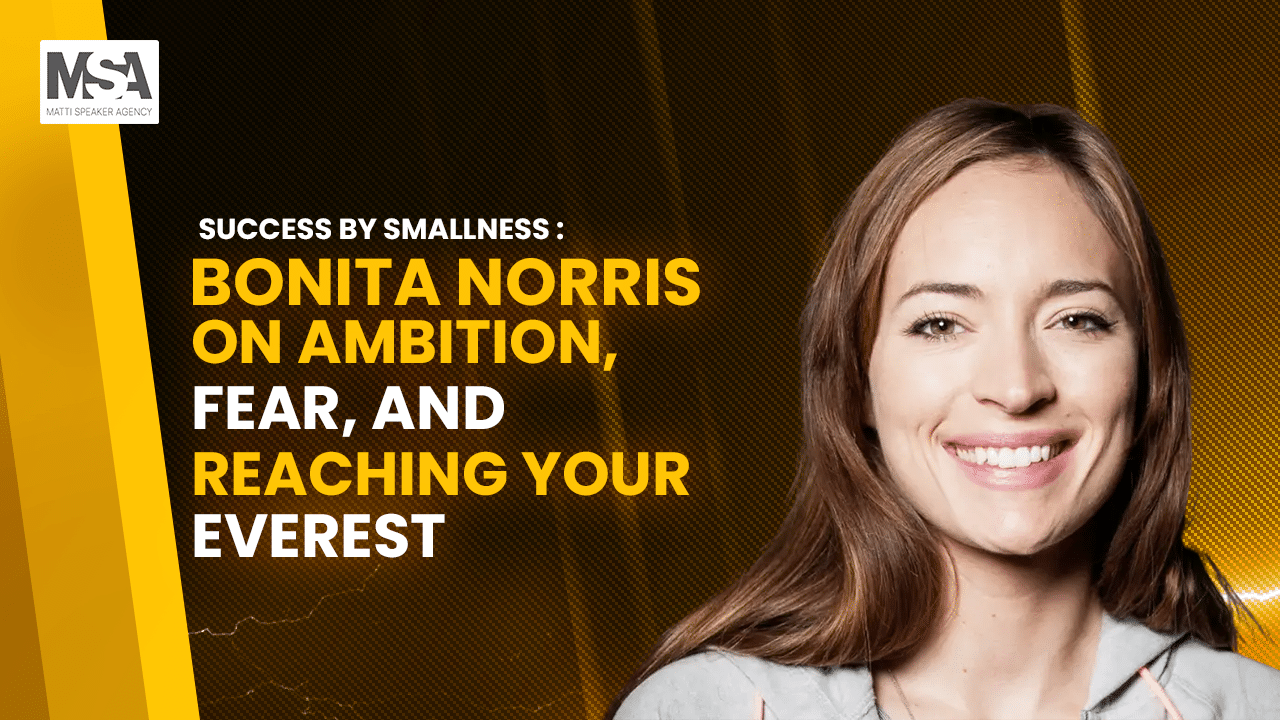
Bonita Norris is more than a mountaineering pioneer. As one of the youngest British women to summit Mount Everest, she has faced some of the harshest conditions on Earth and emerged stronger each time. Today, she is making an impact beyond the mountains as a globally recognized keynote speaker.
Matti Speaker Agency sat down with Bonita to explore the lessons extreme environments teach about leadership, resilience, and fear management, and why taking small, intentional steps what she calls “Success by Smallness” can lead to achieving even the most ambitious goals.
l You went from never climbing a mountain to summiting Everest in just two years – what was the mindset shift that made that leap possible?
It was the understanding that Everest was my dream and my responsibility. Nobody could climb that mountain for me- in the same way, nobody is going to hand you a dream job or your dream life. You can’t wait for permission – you have to take your goals into your own hands and take those steps toward them. I also had to learn patience- to trust the process of incremental gains, which I call Success by Smallness. This is a mindset I often share with women motivational speakers as an example of achieving big goals step by step.
l You’ve faced some of the toughest conditions on earth. What’s one lesson from those extreme environments that’s helped you navigate challenges in ‘professional life’?
Communication. Ask good questions, ask stupid questions, over-communicate – be concise and clear. Never assume everyone is on the same page as you or sees a decision or plan the same way as you. Make sure there is clarity within the team. Good communication in the mountains can mean the difference between life and death, and many entirely avoidable mistakes have been made because of a lack of communication or misunderstanding.
l Fear is something we all face, whether on a mountain or in everyday life. How did you learn to work with fear rather than be held back by it?
I’ve learned that when I’m truly in danger, adrenaline takes over, and I don’t feel fear as I’m so focused on survival. This understanding allows me to keep fear in check- if I feel scared, is it because I am overthinking somewhat?
I try to focus more on assessing the situation and always staying calm. Fear is like a runaway train-it is easy to let it get out of control. Deep breaths and self-awareness will help you emotionally suppress whilst it is necessary to do so, so that you can stay focused on the situation.
Climbing is a great way to confront fear and work through it- and having spent a lot of time feeling scared, I’d say fear is mostly in the mind- our minds are trying to protect us from danger, but as humans we are able to override that survival instinct in pursuit of goals that are meaningful to us. I say in my keynotes that the big things we want in life, that matter to us most, are often on the other side of being brave in small moments. So just remember the next time you’re scared, remind yourself that your bravery in this moment is going to move you closer toward the big stuff that really matters to you.
Managing fear is something we can train pretty quickly with daily exposure, do something that scares you every day and see how quickly your resilience to fear builds. Through this, I encourage women motivational speakers to practice in their own lives and in mentoring others.
l As a keynote speaker, you’ve inspired thousands around the world. What do you hope your audience takes away from your story the most?
To be ambitious, as we are far more capable than we often think, especially when we work together.
l Many people feel like they’re at the base of their own ‘Everest’ right now. What’s your advice for taking the first step when the goal seems impossible?
Focus, not fret. This is a mantra I share in my keynotes, and it has helped thousands of people. “Focus not fret” is a call to action that gets you out of your overthinking mind to taking action in the present moment. Often, we get caught up in worrying about which task needs our priority or where to even start when there’s so much to do – I tell people not to get stuck in that way of thinking.
What is more important when we are feeling overwhelmed is to start with ANY task, as this gets us taking action, it takes our minds off the enormity of our work load and focuses on something we have control over that sense of regaining control builds our confidence and makes us calmer, and once we have started one task, it is easier then to start the next one and the next and once that momentum is built, we are in a better headspace to prioritise the most important tasks. Initially, though, it is that transition, from overthinking to action – that we often find so hard to do in life, so that’s why having a mantra like “focus not fret” is so important, as it can help us make that transition, and in my keynotes, I explain exactly how to use it when it matters most. This strategy is something I often share with women motivational speakers showing how taking small, intentional steps can create big results both on stage and in life.
Book These Speakers for Your Event :
The 2026 calendar is filling up quickly. Make sure your event has the impact it deserves by securing the perfect speaker today. Check availability and book your speaker now at https://mattispeakeragency.com/.